Consider a planet with mass 


The hypotheized intermediary force could manifest as follows:
At position 

for some positive constant 


When considering how this velocity boost affects the zonal winds of another planet 


where 


Let’s see how this affects each planetary phenomena listed in the blog sections page.
Venus’s zonal winds
Since the mass term in the velocity boost expression is in the denominator, then smaller planets will exert a stronger force. However, the frequency of velocity boosts is also important. Mercury and Venus have rotational periods of about 58 days and 243 days respectively. This means the effect they have on other planets occurs much less frequently than say Earth and Mars whose rotational periods are about 1 day.
With this in mind, it is clear that Mars has the greatest effect on Venus. The next thing to consider is the mass contained within S(r,Mars), where r is Mars-Venus distance. During their orbits, S will occasionally contain other solar system bodies. In this case, the bodies that significantly reduce the velocity boost expression are the Sun and Earth.
Finally, the mass of Venus is 7.6 times that of Mars. This means that the velocity boost on the near-side of Venus to Mars will be significantly greater than that which occurs on the far side. For simplicity, only the near-side velocity boost is used.
Therefore, given that Mars-Sun and Mars-Earth distances are greater than Mars-Venus distance, and with the gamma term not rising more than about 1.003, the expression we can effectively use to predict zonal winds on Venus is

where 


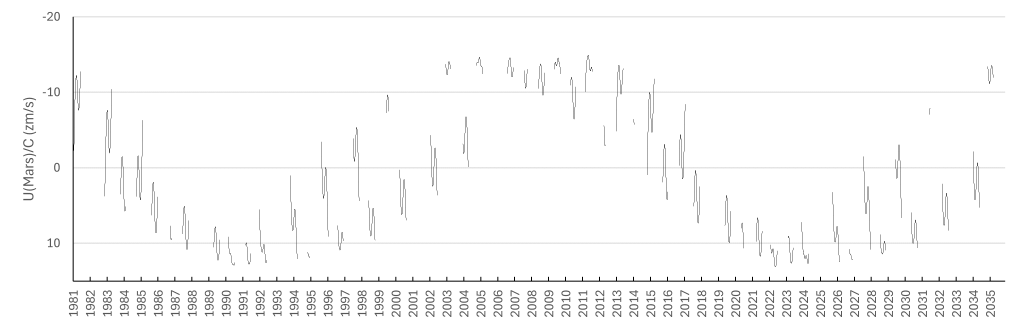
This same expression is also used to explore possible connections with Venus’s cloud discontinuities. It should be noted that Venus’ zonal winds are prograde (westward direction given Venus’ retrograde rotation); so a positive U(Mars) will push against the wind, while a negative U(Mars) will accelerate it. It is hypothesized that the friction caused by a positive U(Mars) will create an atmospheric buildup manifesting as a cloud discontinuity.
Earth’s zonal winds
Again, Mars has the greatest effect on Earth. The mass contained within S(r,Mars), where r is Mars-Earth distance, will occasionally contain the Sun and Venus. We can neglect periods when Mars-Sun and Mars-Venus distances are less than Mars-Earth distance.
The mass of Earth is 9.3 times that of Mars, so that only the significantly greater velocity boost on the near-side of Earth to Mars is used.
With the gamma term not rising more than about 1.004, the expression we can effectively use to predict zonal winds on Earth is

where 

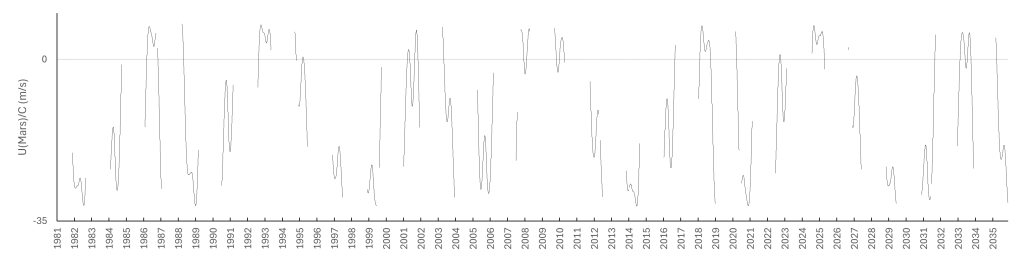
A positive U(Mars) will push the wind from west to east, and vice versa.
Mars’ zonal winds
Earth has the greatest effect on Mars. The mass contained within S(r,Earth), where r is Earth-Mars distance, will occasionally contain the Sun and Venus. We can neglect periods when Earth-Sun distance is less than Earth-Mars distance. However, when S(r,Earth) contains Venus and not the Sun, the velocity boost is only reduced by a factor of about 1.8. Therefore, it is worth considering in addition to periods when S(r,Earth) does not contain the Sun or Venus.
The mass of Mars is about 0.1 times that of Earth, so the velocity boost on the far side will be only marginally less than on the near side. This could complicate any predictions of overall zonal wind speed changes. We can, however, track the periods when these velocity boosts occur, and compare with instances of Marsquakes and dust storms.
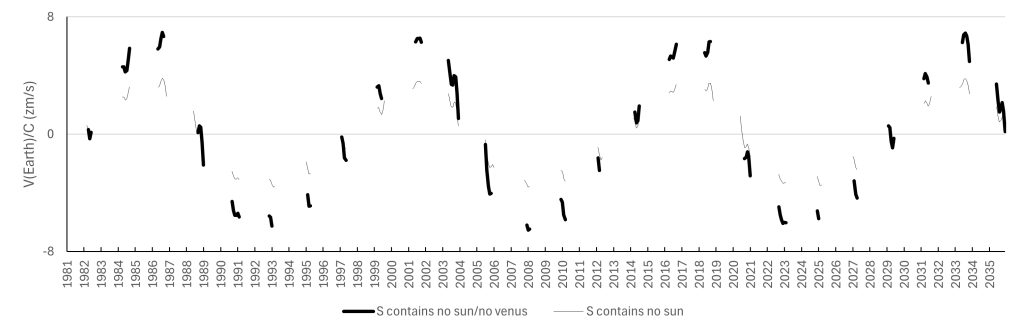
With the gamma term not rising more than about 1.005, then when S(r,Earth) does not contain the Sun or Venus, we can use the expression:

where
When S(r,Earth) contains Venus but not the Sun, the expression is:

where m is Venus’s mass. Assume T is roughly the same as Earth’s sidereal rotational period. For the period 1981-2035, the plot looks like this:
 Lee Talbot Physics Research